Unit 1B, Keynor Farm
Sidlesham, PO20 7LL

8:30am - 5:00pm
Monday - 4:00pm Friday
Blog
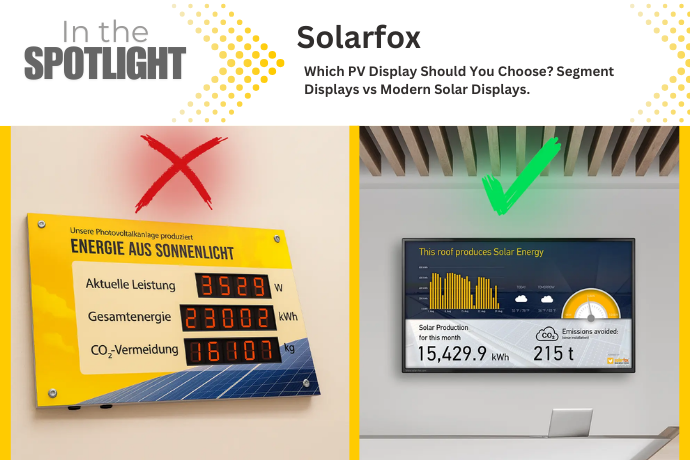
Which PV Display Should You Choose? Segment Displays vs Modern Solar Displays
As more businesses, schools and public organisations install solar PV systems, many are asking an important question:
How can we clearly show the energy our solar panels are producing?
Displaying solar generation is a powerful way to demonstrate sustainability, educate visitors, and communicate environmental impact. However, not all PV display systems are created equal.
Traditionally, segment displays were used to show solar output. Today, modern solar display screens like Solarfox provide a far more engaging and informative way to visualise renewable energy.
In this article, we’ll explore the key differences between segment PV displays and modern solar displays, helping you decide which solution is best for your solar installation.
What Is a PV Display?
A PV display (photovoltaic display) is a screen or digital display used to show the performance of a solar energy system.
Typical information displayed includes:
-
Current solar generation (kW).
-
Daily or total energy production (kWh).
-
CO₂ savings.
-
Self-consumption data.
-
Environmental impact.
For businesses and organisations, a solar display helps make renewable energy visible, turning complex technical data into information that anyone can understand.
What Are Segment Solar Displays?
Segment displays are one of the earliest forms of solar PV display technology.
They are typically LED number displays made up of individual segments (similar to digital clocks or calculators) that can only show numbers. These displays have historically been installed on building facades or in reception areas to show solar production values such as total kWh generated.
Typical information shown on segment displays
Segment solar displays usually show:
-
Current power output.
-
Total solar generation.
-
Energy production in kWh.
They are simple, reliable and relatively low cost.
However, as solar adoption has grown and organisations want to communicate sustainability more effectively, segment displays are increasingly seen as outdated technology.
The Limitations of Traditional PV Segment Displays
While segment displays serve a basic purpose, they have several significant limitations.
1. They Only Show Numbers
Segment displays can only display numeric values.
This means they cannot show:
-
Graphs.
-
Visual dashboards.
-
CO₂ savings.
-
Energy comparisons.
-
Images or branding.
For most visitors or employees, a number like “12,450 kWh” has little meaning without context.
2. They Lack Context
A key issue with traditional solar displays is that they do not explain the impact of the energy produced.
For example, they cannot show:
-
How today’s generation compares with yesterday’s.
-
Environmental benefits such as CO₂ savings.
-
Energy consumption vs generation.
-
Long-term performance trends.
Without this context, solar data becomes difficult to understand.
3. They Are Static and Hard to Update
Segment displays are usually fixed systems with limited flexibility.
Changing content often requires:
-
Manual reconfiguration.
-
Technical programming.
-
Manufacturer involvement.
This makes it difficult to update messaging or add new information.
4. Outdated Appearance
Modern buildings increasingly use digital displays and smart dashboards.
In comparison, large LED number displays can look dated, particularly in offices, schools or modern commercial environments.
Modern Solar Displays: A Smarter Way to Visualise PV Systems
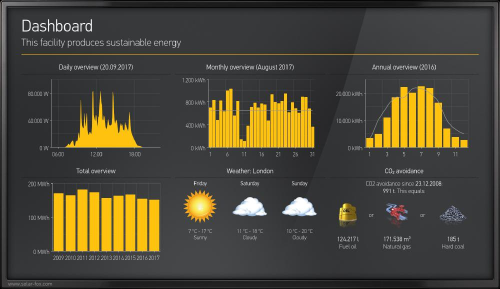
Modern solar display screens such as Solarfox represent the next generation of PV data visualisation.
Instead of simply displaying numbers, these systems turn solar data into dynamic visual dashboards.
A modern solar display can show:
-
Real-time solar generation.
-
Graphs and charts.
-
Environmental impact metrics.
-
CO₂ savings.
-
Energy comparisons.
-
Custom messaging and branding.
This makes solar energy easier to understand and more engaging for viewers.
Key Advantages of Modern PV Displays
1. Visual Data That Anyone Can Understand
Modern solar displays translate complex solar data into visual information.
Instead of just showing a number like:
8,500 kWh
a solar display might show:
-
Equivalent CO₂ savings.
-
Energy generated this month.
-
Household electricity comparisons.
-
Real-time energy flow.
This helps employees, visitors and students immediately understand the impact of solar energy.
2. Real-Time Solar Monitoring
Modern PV displays can connect directly to solar monitoring platforms, automatically displaying live data.
These systems can integrate with monitoring platforms from inverter manufacturers and energy management systems, allowing real-time updates and accurate reporting of solar performance.
3. Remote Management and Cloud Control
Unlike traditional displays, modern solar screens can be managed remotely via an online dashboard.
This allows operators to:
-
Update slides and content.
-
Add logos and branding.
-
Upload images or videos.
-
Change layouts.
-
Display sustainability messaging.
Updates can be made instantly without visiting the display location.
4. Powerful Sustainability Communication
One of the biggest advantages of modern solar displays is their role as communication tools for sustainability and ESG reporting.
Many organisations now use solar displays to:
-
Show their environmental commitment.
-
Educate visitors about renewable energy.
-
Demonstrate CSR & ESG performance.
-
Highlight sustainability projects.
Making energy visible helps strengthen trust and transparency with customers, investors and employees.
Where Solar Displays Are Commonly Used
Modern photovoltaic display screens are increasingly used in:
Businesses and corporate offices
Displaying solar generation in reception areas helps showcase environmental commitments.
Schools and universities
Solar displays can be used as educational tools to teach students about renewable energy.
Public buildings and councils
Local authorities use displays to communicate climate action initiatives.
Industrial and manufacturing sites
Companies can demonstrate sustainability performance to visitors and partners.
Why Many Organisations Are Moving Away from Segment Displays
The difference between segment displays and modern solar displays is similar to the difference between a calculator and a tablet.
Both can show information, but one communicates far more effectively.
Segment displays:
-
Show simple numbers.
-
Provide little context.
-
Offer limited flexibility.
Modern solar displays:
-
Visualise energy data.
-
Communicate sustainability.
-
Provide engaging real-time dashboards.
-
Offer flexible, remote management.
For organisations that want to showcase their renewable energy investment, modern solar displays provide far greater value.
Conclusion: Making Solar Energy Visible
Installing solar panels is a powerful step toward sustainability, but showing that impact matters too.
Traditional segment displays may still show basic generation data, but modern solar display systems transform solar performance into a visual story.
By combining real-time data, visual graphics and sustainability messaging, modern PV displays help organisations:
-
Communicate their green credentials.
-
Educate visitors and employees.
-
Increase awareness of renewable energy.
-
Demonstrate measurable environmental impact.
If your goal is simply to show numbers, a segment display may be enough.
But if you want to make solar energy visible and meaningful, a modern solar display is the clear choice.
Where Solarfox Fits In
Solarfox Displays bridge the gap between simple PV data and meaningful sustainability communication. Instead of only showing numbers like traditional segment displays, Solarfox screens transform solar performance data into clear, visual dashboards that display real-time generation, historical production, CO₂ savings and other environmental metrics.
The displays connect directly to many inverter and monitoring platforms, automatically pulling live data and presenting it in an engaging format that can be easily understood by employees, visitors and customers. For organisations that want to showcase their solar investment and communicate their sustainability impact, Solarfox provides a flexible and visually powerful solar display solution.
Learn more about Solarfox, or buy online here: Solarfox Displays. Got a question? Reach out to us: Contact.